Writing in Place: Part 3
The Living Sanctuary of The Archive—where intercultural mediation speaks to spoken Country in artful Walyalup-Fremantle
Told by Grant Revell (Wadjella)—And Studios1, November 2025.
Everybody has a good story to tell. And most of us like the simple theatre of story-tellers and the generous messages embodied in their personal treasures. On the page or on the stage, humans do like an interactive expression of transformative self and other—especially when their storied experiences are spatial, biographical and grounded in-place. These are mindful, navigational experiences, that help us know where we are, and where we might be going in these crazy and uncertain times.
With Yarning Relationships
This very personal, somewhat scholarly ‘story-yarn’ is about artful relationships. Specific moments in time, spirit and place that hopefully inspire the meaning-making of Fremantle’s Biennale Festival - now considered as one of the world’s very best site-responsive community arts gatherings. In such a short space of time, this arts biennale festival is now renowned for the sharing of grounded stories to help restore the town’s Walyalup-Fremantle identity, life and associated meanings. A mighty task of leadership and hard work for a small collective of community artists and their supporters keen to acknowledge community, place, their respective stewards, and now Country (boodjah) as their bailiwick. Ambitious program goals ‘to reimagine and transform our relationship to place through contemporary culture’ are being realised. And it is this collection of stories, events, experiences and relationships—some residual, light and heavy, some fleeting—that now help form a safe living ‘sanctuary’, library or archive to the life of Walyalup-Fremantle place itself. Although the Fremantle Biennale Festival is now international in the way it successfully attracts its artists and audiences, it is firmly rooted in the healthy and useful knowing and being of Walyalup-Fremantle. Local and regional residents, for example, speak of a certain proudness, respect and belonging when they now engage with the Fremantle Biennale Festival and its community. Some say that it is Noongar boodjah that has brought this uplifting Festival into being.
Back in 2021, the Fremantle Biennale Festival choreographed a theme around the ‘Crossings’. Artists and their audiences were encouraged to explore
“…the contemplation of the river and estuarine systems of the Derbal Yerigan (Swan River) and the manifold real and metaphoric ‘crossings’ we make, across and around the river, across and between people and across and through time. This is a place of alchemy where living histories intersect and collide, where the bilya (river) meets the wardan (sea) in a collection of places of significant confluence–real and imaginary–for yesterday, today and tomorrow…”2.
The 2021 festival was highly acclaimed in multiple ways, obviously and not so obviously. And, for me, personally, it is the ‘unknowing’ of many of the programs ‘ricochet’ achievements and hidden secrets that is worth further exploration. Here the Aeolian-like sediment, essence or spirit of site-responsive contemporary art is revealed as a means of becoming an itinerary to community and place. These residual, sometimes ephemeral qualities of Walyalup-Fremantle boodjah become the touch stones to a remapping of reciprocal care.
Conciliatory Efforts Revealed
One significant (behind the scenes) set of moments within the 2021 Biennale Festival program was the careful development of the ‘Creative Conciliation’ initiative where artists and advisers would come together to help generate inspirational momentum with shared ideas around place-based art and cross-culture making. It was and still remains a generous and respectful ‘think-tank type of landscape’ so artists can be guided and grounded in place and Country - real or imaginary. Whadjuk cultural advisers gave their time, energy and knowledge to this social and conciliatory process. There was a lot of generous love going round. Some artists embraced the reflective critique and knowledge offering more than others. Some found it tense and difficult, disturbing and somewhat confronting as heartfelt truth-telling was experienced first-hand. Walyalup-Fremantle’s living history and sense of place is not ‘all roses’, of course. And in the context of Western Australia’s own living histories and heritage the stories can be horrific and shameful. But the truth-telling was shared carefully and often safely reciprocated with other relational stories. To be fair, most of the proposed art work was strengthened with the input of the Creative Conciliation process. I have written elsewhere that these performative processes of turning over artful stories and yarning up design concepts are indeed works of art in themselves. For the relationship can be the project. And all the in-between bits and pieces can be tangible and revelatory3. I think the festival’s audiences now look for the artful evidence of those genuine relationships. Some now call it the “Fremantle Biennale Method”. And many are trying to figure out how these artful interactions can be creatively documented or further turned into other emerging forms of site-based art-making.
Of course, time, spirit and space has moved on since those careful cross-cultural meanderings in 2021. The Creative Conciliation program of 2021 gave subsequent birth to the Biennale’s Whadjuk Cultural Advisory Panel. Where shared specialist Whadjuk knowledge and ways of working would be common place to the now Walyalup-Fremantle Biennale Festival. Quite an achievement, really. Now envied by many town and city arts programs and festivals of-like around the globe.
The Fremantle Biennale now has a strong relationship with its local Whadjuk Noongar community, with the formalisation and care of its Cultural Advisory Panel and the real meaningful employment and just recognition of Whadjuk artists, elders and their community administrators. Walyalup-Fremantle has learnt new and old ways to encourage artful representation of itself cross-culturally. Real change making, self determination, sovereignty, authenticity, scholarship and truth telling has been at the core of this artful reckoning. With deep site-responsive inquiries, artists can no longer ignore their own respectful place within the world’s oldest living culture here in Walyalup-Fremantle.
The latest Biennale program for 2025 now gives formal recognition to this Creative Conciliation initiative by saying - “The Fremantle Biennale are engaged in an on-going process of what we call creative conciliations – these are yarns between artists, Nyoongar Elders, Cultural Knowledge holders and emerging leaders, which have and will continue to guide our programming.”4 This clear acknowledgement by the Biennale Festival leaders strengthens the intent of why artful advice and knowledge sharing is important to place and Country. This ethical sanctuary of reflexive care opens up important ways of how cross-cultural and artful truth-telling can help us to work towards living together on Country, with the gifts, knowledge and stories of and with culture we are invited to share. Importantly, as noted by the editors of the stand-out community research publication ‘The Politics of Public Space’, “A positive way forward for Aboriginal and non-Indigenous designers [and artists] is to collaborate, by first understanding on whose terms these collaborations are built.”5 It has been the work of the Biennale’s Cultural Advisory Panel to ensure that this ‘understanding’ and these ‘terms’ are maintained and exercised in generative, creative and respectful ways.
Different Ways of Knowing, Practicing
It was spatial theorist and design educator Danièle Hromek, a Saltwater woman of Budawang/Dhurga/Yuin and Burrier/Dharawal ancestry, with French and Czech heritage, who recently defined an operandi treatise to assist non-Indigenous architects wanting to learn how to design with Country. Fourteen (14) interconnected principles were developed alongside some of her built environment collaborators, illustrated below, and gifted to her readers. They are all relevant for Country and site-responsive artists. From starting with Country, with its caring and reconciliation, to knowing of one’s own motives and desires, to the respect of de-centring humans, being present, designing safe and slow with the rightful knowledge holders and stories of Country, and to the knowing of when to share the load, stop, and not over design the relationships or the project6. Interestingly, many of these principles, or their common associations, have been employed by the Biennale’s Creative Conciliation sessions which incorporated the Nyungar design thematics developed by Whadjuk researcher and cultural adviser Len Collard7. In turn, these collective efforts have become the shared language of Walyalup-Fremantle.
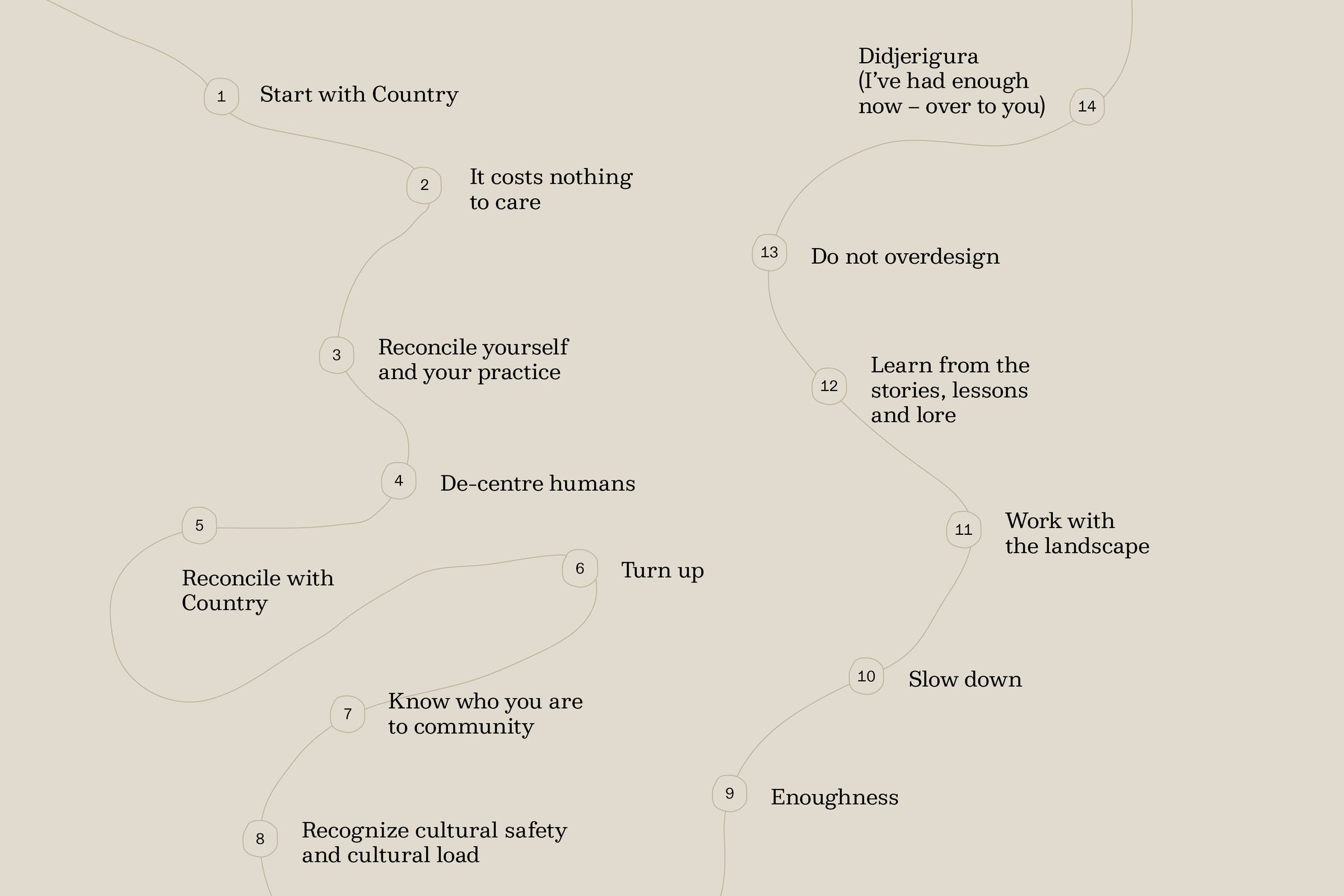
These generous and careful ‘terms of collaborative business’ now provide new/old respectful ways of working collaboratively for non-Indigenous place-based artists concerned with the health and wellbeing of Country-centered place. Where place and Country combined can be considered an artful sanctuary of relational well-being and Indigenised practice.
Conversely, for those artists that search for site and don’t necessarily wish to concile themselves with the cultural tension and burden of living site-histories, or their work to relational Country, justly First Nations-lead, and on First Nations terms, then perhaps knowing the other specificities of place could become an ethic of reciprocity to many. This ethic of inquiry, or aesthetic in the making, could still be considered as a generative flash point to begin with. To rephrase the work of Australian ethno-geographer Debra Bird-Rose, many artists and designers might alternatively learn that ‘if you find a (new/old) way to love place, then place may find a (new/old) way to love you.’ Where the genuine human intentions and acts of loving and reciprocity may become the well-spring for mutual care and stewardship in the social and built environment. Arguably, this could be a good multi-valiant start for many socio-cultural collaborative conditions in Australia - especially here in Walyalup-Fremantle. Where a shared sensed of trust and environment is (finally) turning over to landscape and then to Country at surprising rates. Where Country and its traditional living stewardship is collaborating willingly and speaking loud and clear. And many are listening. Some hesitant, and some with open hearts, arms and minds. It is also clear that the now hard-fought modus-operandi and method of the Walyalup-Fremantle Biennale Festival has contributed to that strong and growing sense of community well-being.
A Future Festival of Mediation
Meanwhile, as we get close to the 2025 Fremantle Biennale Festival program it is not so surprising that the thematic of the ‘Sanctuary’ is to be suitably recognised as the impetus of new site-responsive works of contemporary art, and new relationships between artists and their advisers with Nyoongar boodjah. Here the Biennale team outline this overarching and compelling theme of performing boodjah -
“SANCTUARY 25 will engage in a reimagining of public and personal spaces. It calls for alternate frameworks of democratic citizenship and new assemblies for solidarity and community. (…) [To] include moments and invitations of safe haven, alongside practices and temporalities that explore resistance, experimentation and insurgency. In the continuously shifting climates of the here and now, sanctuaries can be considered as testing sites for remediation, regenerative models and for remapping sacred geographies.”8
One conscientious and generative way to explore the idea of the ‘Sanctuary’, as I have previously mentioned, is to head for the archive of place, contemporary or historic. Both living. And to assist with this exploration I am drawn once again to the little known spatial and biographical histories and events that need to be retold in a context of intercultural reciprocity and relationship building. Where a refugia of shared stories expand on the untold mediation between First Nations and non-Indigenous peoples in Western Australia - importantly Walyalup-Fremantle. And not so much within the inescapable power, control and character of the colonial archive.
To help, it is important to recognise the more recent scholarship given to the intermediary or cultural facilitation role played by First Nations people - namely in the collaborative work of Yawuru and recent University of Western Australia humanities researcher Shino Konishi9. Here Konishi explores the local and international archive to reveal how Indigenous people played a role of agents, guides, translators, and hosts that assisted and facilitated the imperial and colonial exploration of European travellers in different parts of the world. The intermediary First Nations tracker played by David Gulpilil (RIP) in the Rolf de Heer’s 2002 Australian film drama ‘Tracker’, for example, is a well known piece of Australian filmic history that reveals these often fraught and perplexing cultural mediation and intermediary relationships during colonial exploration.
Conversely, little is known about the useful non-Indigenous intermediaries who played similar roles in colonial history. Where European skills and cultural know-how became useful in the Indigenous-European encounter. For Walyalup-Fremantle, notable identities include Francis Armstrong (1813–1897), a Scottish Methodist pioneer of the Swan River Colony and native interpreter, moral agent, and store keeper on Wadjemup (Rottnest Island) and at the Native Institute on the Derbal Yerrigan (Swan River) in Crawley. Others include Irishman Fletcher Moore (1798–1886) noted as one of the key figures in early Western Australia’s ruling elite; and outspoken settler Robert Menli Lyon (1789–1874) who became one of the earliest advocates for Indigenous Australian rights and welfare in the Swan River Colony.
All three of these notable non-Indigenous intermediaries were amateur linguists, presumably motivated and fascinated by the shared opportunities they were given to study, animate and record spoken forms of Noongar. As are their archival contemporaries Peter Bindon and Ross Chadwick from the Western Australian Museum who continue to work alongside Noongar.
A Conscientious Site of Spoken Sanctuary
To further explore the artful narrative of hidden living histories, the research of the archive for the preparation of this ‘yarn-essay’ has revealed an interesting story for the Biennale. A further gift, maybe, to the Sanctuary of Walyalup-Fremantle. Excited by further yarns with the Biennale’s co-founder and CEO Tom Muller, together we have focussed on the living history of local Gnooroolmayup (Carnac Island or Bald Island) - located and clearly visible just 10 kms off the shore from Walyalup-Fremantle. Gnooroolmayup is perhaps the lesser known island boodjah to nearby sisters Wadjemup (Rottnest Island) and Meeeandip (Garden Island) who have contributed to previous Biennale Festivals. Gnooroolmayup has a rich history of being the conservator of bio-geographical intrigue with its isolated and inaccessible existence and over-run sanctuaries of rare Australian sea lions and strange tiger snakes. This zoological intrigue caught the gaze of film-maker David Attenborough who once did a feature documentary on the island in 2008, suitably named ‘Sophisticated Serpents’ capturing the island’s wildlife wonders including the rare blind and fat tiger snakes10. These one of-a kind tiger snakes are noted as possible imports from the carnival shenanigans of local showman Rocky Vane and his wife, performers at ‘Uglieland’’, operating in Fremantle until 1936. Weirdly enough, Rocky’s first wife died of snake bite in 1928 and his new partner Harry Melrose was also bitten and died in 192911.
Surprisingly, this small refugia of rare island-ecology has been caught in the written archive of only just a few Western Australian biological scientists - namely in the individual and collaborative work of Ian Abbott, B Brian Bush and Don Bradshaw. Presumably Attenborough drew upon these significant life-long research achievements. The popular ‘behind the science’ stories of these local spell-bound researchers, and others, and their special love of local Noongar boodjah, are pretty much untold.
Closer within the archival sanctuary of Gnooroolmayup we learn about the intriguing cultural advocacy work of Robert Menli Lyon and its now importance to the Fremantle Biennale. The preliminary voice of Wikipedia and local contributor and Western Australian Historical Society scholar Bob Reece speaks:
“Beginning about December 1831, a Noongar named Yagan had been leading a number of attacks on settlers in retaliation for the killing of one of his friends. In October 1832, Yagan and two of his compatriots were captured and sentenced to death. However, Lyon interceded, arguing that the men were fighting for their country and comparing their actions to those of William Tell and William Wallace. Therefore, he argued, they were not common criminals but prisoners of war and entitled to be treated as such. Governor James Stirling then agreed not to execute the men, instead exiling them to Carnac Island.
Lyon was granted access to the prisoners and spent a little over a month on Carnac Island with them. He used much of that time in an effort to learn Yagan’s language. He discovered the names of many local geographic features and acquired knowledge about the Noongars’ culture and traditions. This information was published in a series of editions of the Perth Gazette in March 1833, under the title A Glance at the Manners and Language of Aboriginal Inhabitants of Western Australia. It was the first information of its kind published in Western Australia and remains a valuable resource for anthropologists.
Lyon remained on Carnac Island from 8 October until 15 November 1832, when Yagan and a companion stole an unattended dinghy and escaped to the mainland. On reporting to the governor, Lyon asserted that if he had had three more weeks with Yagan, he might have been able to negotiate a treaty between the natives and the settlers. He urged the governor to pursue a treaty, rather than continuing hostilities. His advocacy against the use of force made him increasingly unpopular with settlers and the government. In retrospect, it also revealed his misunderstanding of Aboriginal culture, whose tribes acknowledged no leaders with whom a binding treaty might be negotiated.
In June 1833, a meeting was called at Guildford in response to continued calls for punitive action against the Aboriginals. Lyon attended and delivered “one of the most distinguished humanitarian speeches delivered in colonial Australia.”12
There is much in this fascinating story that is worth further scholarly investigation especially in the way Lyon Indigenised his own work practices. And presumably how these intercultural hybridised relationships prospered primarily for the health and well being of local Noongar people. The more recent 2024 research work of local historian Errol Allen is most useful here, where Lyon’s little known story and hard work is given further relevance and conciliatory explanation13. Moreover, my own preliminary investigations are indeed very preliminary, without belittling or being mistaken of the tragic fact that Yagan, and others were later executed by the colonial encounters they trusted and relied upon. But here we have a little known historical encounter in a cave on nearby Gnooroolmayup that gave birth to the first ever annotated Noongar Wordlist, co-compiled by Lyon and his so-called ‘captives’ - Yagan, Donmera and Ningina. Here we have the beginnings of the Noongar Dictionary of today, now used extensively by Noongar people that wish to reclaim their own sovereign language of place, of Noongar boodjah. Where spoken Noongar language, together with the complexities of translating Noongar, was shared in exhausting, often inhumane imperial and colonial contexts.
Without over emphasising the importance of this co-written form of ancient spoken knowledge, for many Noongar have learnt their language from their own ancestors, this is the now the key guiding text of the Noongar Language Centre of Perth, and its consequential impacts on its own programs of self determination, restoring family health, creative conciliation and the restored knowing of Country is nothing short of amazement. The historical and contemporary significance of this co-authored Noongar Wordlist, this spoken annotated ancient sanctuary held between Lyon and his now Aboriginal friends, and eventually the compilation of the dictionary, are unfathomable. Likewise, I can’t quite imagine the lasting impacts that Lyon’s collaborative discussions had on the importance of realising a potential treaty.
Local historian Errol Allen highlights a poignant moment in this linguistic, potentially life-threatening encounter when “On the first Sabbath, Lyon assembled the group for divine service and accordingly records ‘Carnac, probably for the first time since creation, heard the sound of a [Noongar] prayer’”.14
WA Museum curators and researchers Peter Bindon and Ross Chadwick would later collate and further expand the Lyon Nyoongar Wordlist into published form in 1992 - another example of the useful work of contemporary non-Indigenous intermediaries.15
But in this collective reckoning of history we now need to ask whose story is this to tell. For our Biennale ethics are well in place now. We can ask whose hybridised cultural story is this, and how might it best form the beginnings of further yarning into possible collaborative art form for the 2025 Biennale Festival? The story yearns for further creative conciliation, perhaps. For it might be best left alone. We must seek guidance and due process from the Biennale’s Cultural Advisory Panel.
Nonetheless, one useful contemporary outcome of this hybridised story could be considered in the cross-cultural remapping of Gnooroolmayup as an international site of conscience. Where its own physical isolation could help protect its own significant story by ‘preserving memory, promoting truth and pursuing justice’, rather than being trampled upon as a tourist destination. The Fremantle Biennale Festival could find art form in how Gnooroolmayup could suitably gain worldly recognition for the greater good and self determination of First Nations peoples here in Walyalup and around the globe. For the time being, the application and registered nomination of Gnooroolmayup might be just enough. As their website explains - “The International Coalition of Sites of Conscience has a network of more than 350 Sites of Conscience in 65 countries, that engage tens of millions of people every year in using the lessons of history to take action on challenges to democracy and human rights today.”16
In Closing
Hidden histories, spoken language and encountered relationships are now important to the Fremantle Biennale Festival. Where little known living histories are retold courageously and artfully, as culturally hybrid enterprises. Where places of colonial exploration and First Nations sovereignty are recast, remapped, as a collective of shared contemporary relations. It is now the intention of this place-based ‘story-yarn’ to resuscitate the archive or the sanctuary of history through the lens of these encounters, interactions, and relationships. To be possibly retold and interpreted by Noongar artists and collaborators as the text of the Sanctuary turns into other potential forms for the 2025 Festival (or beyond) - like the potential nomination and recognition of Gnooroolmayup as an international Noongar site of sacred conscience.
For Gnooroolmayup - with its multiple and significant living Dreamtime stories, hybridised histories and associated meanings as the “place of little brother”17, (with Wadjemup being the big brother?), or the “place to be frightened of ”18 - can be told by the Whadjuk traditional owners, and respectfully by others, with the life-filled vigour, health and recognition that it justly deserves. With guidance, the Fremantle Biennale Festival has now earned its shared collaborative place to do that on and in Whadjuk boodjah. On just terms.
And as a part of a loving Walyalup-Fremantle community we must be forever thankful for that.
End, For The Time Being19
-
I would like to begin by acknowledging the Whadjuk Nyoongar people on whose boodjah in Walyalup-Fremantle we live and work while compiling this ‘story-yarn’. Grant Revell lives in Walyalup-Fremantle and is founder and director of And Studios - a local cultural art & design think-tank devoted to the shared loving, caring and story-telling of special Walyalup-Fremantle. Grant was a cultural advisor and collaborative writer for the 2021 Fremantle Biennale Festival. This paper was prepared for the Fremantle Biennale 2025 and is now incorporated in his Walyalup-Fremantle place project lovingplace.net ↩
-
Muller, T., Ashe, K., Harben, S. and Revell, G. (eds), Foreword in Bilya Bidi Crossings, a monograph of the Fremantle Arts Biennale Crossing 21 Program, Fremantle, Western Australia, 2021, p. 3. ↩
-
See: Muller, T., Ashe, K., Harben, S. and Revell, G. (eds), Bilya Bidi Crossings, a monograph of the Fremantle Arts Biennale Crossing 21 Program, Fremantle, Western Australia, 2021, including Collard, L. and Revell, G. ‘Ekphrastic Walyalup’, pp. 13-22. ↩
-
https://fremantlebiennale.com.au/ Accessed 25/04/25 ↩
-
Sophia Pearce and Jock Gilbert, Politics of Public Space, Volume 4, pp 382-393. Quoted in Foreword, (eds) Politics of Public Space, 2024, Volume 5, p. 8. Published by OFFICE, Melbourne, Australia. ↩
-
See: Architecture Media’s - https://architectureau.com/articles/designing-with-country-what-can-non-indigenous-designers-do/. Accessed 14 July, 2023. ↩
-
Revell, G., and Collard, L. (2015). Wedjumup Wangkiny Koora, Yeye and Mila Boorda - Wedjemup Talking From the Past, Today and the Future. An Ex-Modern Way of Thinking Landscape into Country? In Cultural Mapping as Cultural Inquiry, W.F. Garrett-Petts & N. Duxbury (eds.), Routledge, 2015. ↩
-
https://fremantlebiennale.com.au/ Accessed 25/04/25 ↩
-
Indigenous Intermediaries: New Perspectives on Exploration Archives, Konishi, S. (ed.), Nugent, M. (ed.) & Shellam, T. (ed.), Sept 2015, Australia: ANU Press. ↩
-
See: https://davidattenborough.fandom.com/wiki/Life_in_Cold_Blood Accessed 25/04/24 ↩
-
Mitch Ladyman, Earle Seubert & Don Bradshaw, The origin of tiger snakes on Carnac Island. Journal of the Royal Society of Western Australia, 103: 39–42, 2020. ↩
-
https://en.wikipedia.org/wiki/Robert_Menli_Lyon Accessed 10/04/24. ↩
-
Errol Allen, ‘In Yagan’s Words - A Contemporary Interpretation of Robert Menli Lyon’s 1832 Wordlist from Yagan, Donmera and Ningina on Ngooloomayup (Carnac Island), Western Australia, 2024. Self published. ↩
-
Errol Allen, ‘In Yagan’s Words - A Contemporary Interpretation of Robert Menli Lyon’s 1832 Wordlist from Yagan, Donmera and Ningina on Ngooloomayup (Carnac Island), Western Australia, 2024. Self published. ↩
-
Peter Bindon and Ross Chadwick. 1992. A Nyoongar Wordlist From The South West of Western Australia, Western Australian Museum, Perth, Western Australia. ↩
-
https://www.sitesofconscience.org/our-work/. Accessed 30/04/24 ↩
-
https://www.charter1.com.au/destinations/carnac-island/. And https://library.dbca.wa.gov.au/static/Journals/080052/080052-22.031.pdf Accessed 01/03/24 ↩
-
https://www.noongarculture.org.au/noongar-words/ngooloormayup/. Accessed 01/03/24 ↩
-
I would like to thank Tom Muller, Katherine Wilkinson, Walter McGuire, Sandra Harben and Len Collard for their inspiration for being involved with the Fremantle Biennale Festival. Long live our heart-felt, caring and artful relations in Noongar boodjah. ↩